
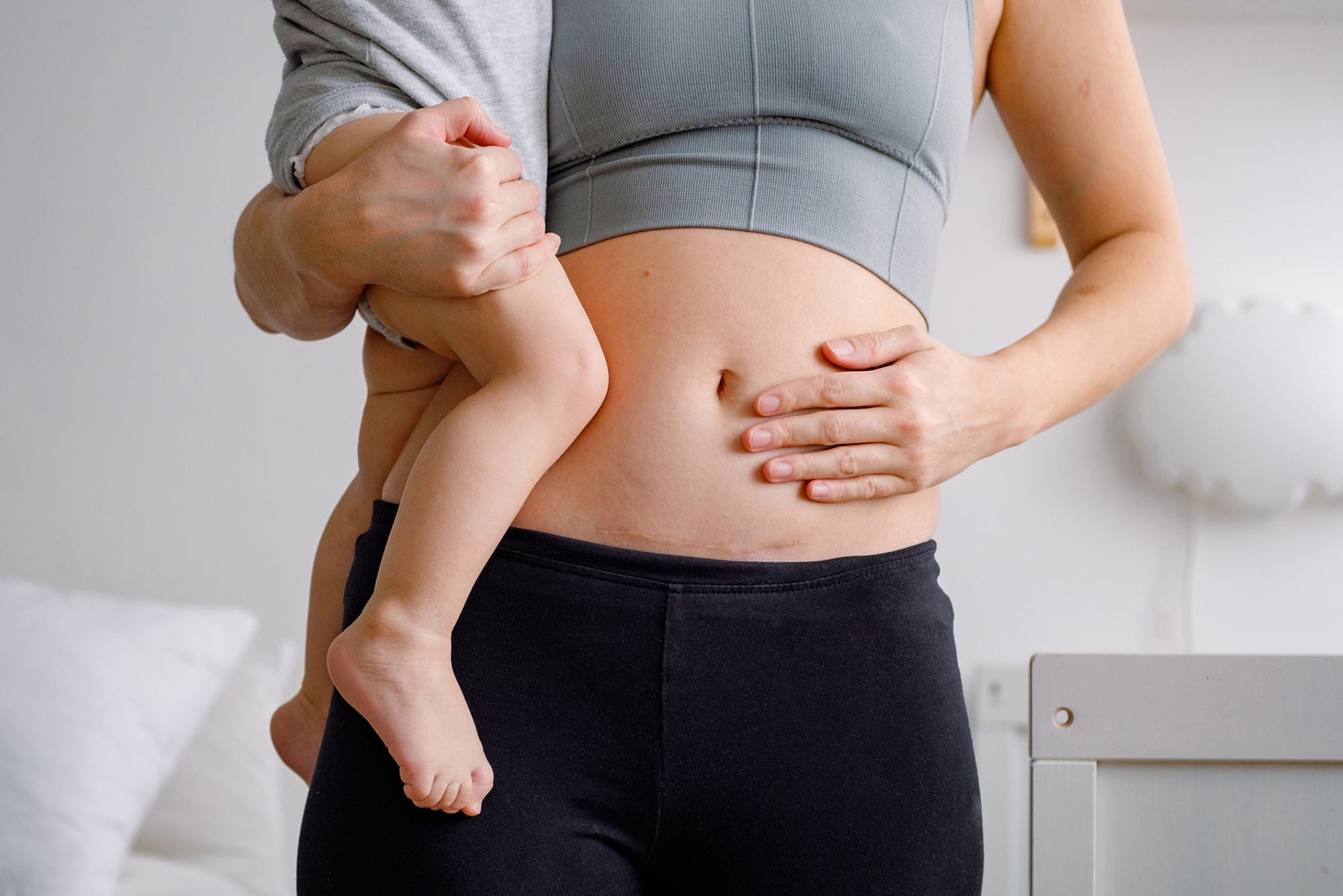
A C-section can leave changes that linger long after you have healed from childbirth. You may notice a low abdominal scar, loose skin that folds over the incision, stubborn fullness, or a belly that still protrudes despite exercise and weight loss. If your abdominal muscles separated during pregnancy, you may feel that your core never regained its strength or shape.
At Quintessa Aesthetic Center, serving patients across Milwaukee, Madison, Green Bay, and Wisconsin communities, a mommy makeover can be tailored to the changes that matter most to you. For women who have had a C-section, a personalized plan may include a tummy tuck, scar improvement, diastasis recti repair, liposuction, or breast surgery. Understanding timing, scar placement, and muscle repair can help you decide when surgery fits your goals.
How your C-section scar is handled during a tummy tuck
If you are considering a mommy makeover after a C-section, you may wonder what happens to the scar you already have. In many cases, a tummy tuck can address both excess abdominal skin and the appearance or position of an existing C-section scar.
A standard C-section incision is usually positioned low on the abdomen. A tummy tuck also typically involves a horizontal incision placed low enough to be concealed by many styles of underwear or swimwear. Depending on the location of your scar and how much skin is being removed, your surgeon may incorporate the C-section scar into the tissue removed.
This means the old scar may be removed along with excess skin, and the new tummy tuck scar may be positioned lower or more evenly across the lower abdomen. If the C-section scar cannot be completely removed, your surgeon may still be able to improve the surrounding contour.
A tummy tuck does not eliminate the need for a scar altogether. Instead, the goal is often to exchange loose skin, a distorted abdominal contour, and an unfavorable C-section scar for a smoother abdomen and a strategically placed surgical scar.
What diastasis recti is and why it’s so common after pregnancy
Diastasis recti refers to separation between the two vertical rectus abdominis muscles that run along the front of your abdomen. These are the muscles commonly associated with a “six-pack.” Between them sits a band of connective tissue called the linea alba.
During pregnancy, your uterus expands considerably. To create room, the abdominal wall stretches and the linea alba becomes thinner and wider, allowing the right and left sides of the rectus muscles to move farther apart. Some degree of separation is normal.
After childbirth, that connective tissue may gradually tighten again. However, it does not always return to its previous width or tension. When a gap remains, you may be left with diastasis recti. Cleveland Clinic reports that diastasis recti affects about 6 in 10 women after childbirth, and about 45% of women still have diastasis recti at six months postpartum.
You may notice a persistent abdominal bulge, weakness through your core, coning or doming when you engage your abdominal muscles, or an abdomen that continues to project forward even after you return to your usual weight. Diastasis recti itself is not painful, but the associated core weakness may contribute to issues such as poor posture or back discomfort.
Several pregnancy-related factors help explain why this condition is so common.
Your growing uterus stretches the abdominal wall
Your abdominal wall has to accommodate dramatic changes during pregnancy. As your uterus expands, it creates outward pressure against the rectus muscles and the tissue between them.
The linea alba is designed to stretch, which allows your abdomen to expand. After delivery, it can retract to some extent, but the tissue may remain stretched even after it has lost elasticity. This is much like repeatedly stretching a rubber band: eventually, it may not return to its original shape. That laxity can leave the muscles farther apart than they were before pregnancy.
Multiple pregnancies can place repeated stress on the tissue
Each pregnancy places another period of stretching on your abdominal wall. If you have had several pregnancies, the linea alba may have been repeatedly stretched and relaxed. This does not mean you will necessarily develop persistent diastasis recti, but repeated pregnancies can increase your likelihood of abdominal separation remaining after delivery. The risk can rise with each additional pregnancy, and closely spaced pregnancies may also be a contributing factor.
Carrying multiples or a larger baby can increase abdominal expansion
Pregnancies are not physically identical. If you carried twins or triplets, or if your baby was larger, your abdominal wall may have needed to stretch farther to accommodate the pregnancy. The greater expansion does not automatically mean you will have severe separation afterward, but it can place more strain on the linea alba.
How a tummy tuck repairs diastasis recti
Exercise can strengthen your abdominal muscles and may improve some cases of diastasis recti, particularly when separation is mild. However, exercises may not restore significantly stretched connective tissue or close a persistent gap.
When diastasis recti is repaired during a tummy tuck, your surgeon lifts the abdominal skin and tissue to access the muscles. The repair uses plication, a technique that places strong sutures in the connective tissue between the rectus muscles to bring them closer together. The muscles themselves are generally not cut or removed. Instead, the surrounding tissue is tightened to create a firmer, more supported abdominal wall.
The American Society of Plastic Surgeons describes this as suturing the connective tissue between the rectus muscles, making the procedure more involved than a tummy tuck focused only on excess skin. After repairing the muscle separation, your surgeon can remove excess skin and, when appropriate, use liposuction to refine nearby areas. These techniques can address stretched skin, laxity, stubborn fat, and sometimes an existing C-section scar.
Timing your mommy makeover around a C-section recovery
A C-section is major abdominal surgery, so your body needs adequate time to heal before you undergo another elective operation in the same general area. For many patients, waiting about six to 12 months after childbirth provides time for the C-section incision to heal, tissues to settle, weight to stabilize, and the abdominal wall to recover.
Your ideal timing may be different depending on your health, breastfeeding status, family plans, and the procedures you are considering. Rather than choosing surgery based on the calendar alone, several signs can help determine whether you are ready.
Your C-section incision has fully healed
Your external incision may appear closed relatively quickly, but the deeper tissues continue to heal for months. Giving your scar time to mature allows redness, firmness, swelling, and any sensitivity to settle. Scar tissue often changes substantially during the first year after surgery, which also gives your plastic surgeon a clearer picture of how the scar has healed and how it may be incorporated into a tummy tuck. If you have ongoing pain, drainage, wound problems, infection, or scar changes, those concerns should be evaluated before elective surgery.

Your weight has become relatively stable
Pregnancy and the postpartum period can involve major weight changes. It is generally helpful to reach a weight you can maintain before a mommy makeover. A tummy tuck reshapes tissues at your current size rather than serve as a weight-loss operation. Losing a substantial amount of weight after surgery may create new laxity, while significant weight gain can stretch your results. You do not need to pursue an arbitrary number on the scale. The more useful goal is to reach a healthy, sustainable range that reflects how you expect to live long-term.
You have finished breastfeeding, or your body has stabilized
If your mommy makeover includes breast surgery, your breasts should have time to settle after breastfeeding ends. Breast size and shape can continue changing for several months as milk production stops and breast tissue stabilizes. Waiting allows your surgeon to evaluate the volume loss, sagging, asymmetry, or other concerns that remain rather than operating while those changes are still occurring. Your surgeon can advise you on the appropriate interval.
You have given diastasis recti time to improve naturally
Not every abdominal separation requires surgery. Physical therapy and exercises that appropriately engage the deep abdominal muscles may help some women improve diastasis recti. Conservative treatment such as targeted exercises or physical therapy may be appropriate before surgery in some cases. Waiting several months also allows you to see which changes resolve as your postpartum recovery progresses and which remain despite consistent effort.
You are not planning another pregnancy soon
You can become pregnant after a tummy tuck, but another pregnancy can stretch the repaired abdominal wall and skin again. If you know you want another child in the near future, postponing your mommy makeover may help preserve your surgical results and prevent the recurrence of muscle separation or skin stretching. Being finished with childbearing is not an absolute medical requirement, so your individual circumstances should be part of the conversation.
You are physically and practically prepared for recovery
Readiness also means having time and support to recover. Following a tummy tuck, you will temporarily have restrictions on lifting, strenuous activity, and exercise. That can be especially important when you have a baby or young children who normally need to be carried. Plan for reliable help with childcare, transportation, and other responsibilities. Trying to return to heavy lifting too soon can place unnecessary stress on healing tissues and your abdominal repair.
Explore your mommy makeover options at Quintessa Aesthetic Center
If you’re concerned about a C-section scar, loose abdominal skin, persistent abdominal bulging, or separated abdominal muscles, a mommy makeover may help address multiple concerns within one personalized surgical plan. The goal is not to erase the changes that came with pregnancy or childbirth, but to address the areas you would personally like to improve.
At Quintessa Aesthetic Center, board-certified plastic surgeons Dr. Daniel Butz and Dr. Jake Thayer perform body surgeries and create individualized plans based on your unique anatomy, recovery, lifestyle, and goals. With locations serving Brookfield and the greater Milwaukee area, Middleton and the greater Madison area, Sheboygan and the greater Green Bay area, and Mequon and Delafield, Quintessa offers personalized care across Wisconsin.
Schedule a consultation to discuss your C-section scar, abdominal muscle separation, timing, and the mommy makeover approach that may help you feel more like yourself again.

Medically Reviewed by: Dr. Jake Thayer
Board-Certified Plastic and Reconstructive Surgeon
About Dr. Thayer